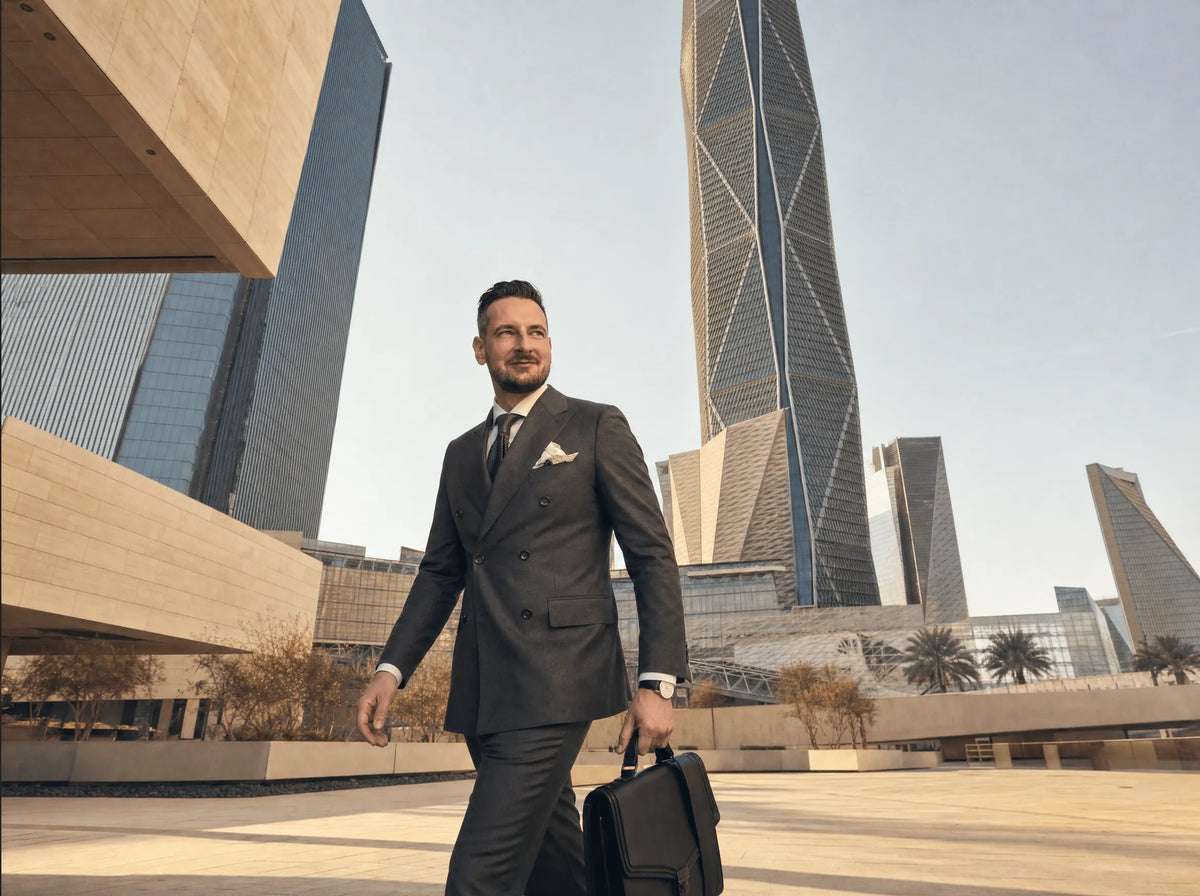

Riyadh Business Event Dress Code for Men: What to Wear to FII, LEAP and Beyond
For most Riyadh business events, a man should wear a well-fitted navy or mid-grey suit in a lightweight, crease-resistant wool, with a crisp shirt and dark leather shoes. At the most senior gatherings, such as the Future Investment Initiative (FII), wear a tie. At LEAP and other tech events you can lose the tie, but keep a proper jacket. For a black tie gala, wear a dinner suit. Below is how to read each room.
I've watched men lose a room before they've said a word.
Not because they were underdressed. Because they misread what the event was asking of them. They wore the suit that worked for a London board meeting to a Riyadh conference floor, and it read as a man who hadn't done his homework. In a city where business runs on relationships and first impressions compound, that's an expensive mistake.
This article is about reading the room before you walk into it. FII, LEAP and the dozen other gatherings that now fill Riyadh's calendar each have their own dress logic. Most men never learn it. They guess. I want you to stop guessing.

What the Riyadh dress code really means
Dress codes printed on an invitation tell you almost nothing. "Business attire" at FII and "business attire" at a regional trade conference are two different instructions wearing the same words.
The real code is unwritten. It's set by who else is in the room, what's at stake in the conversations, and how the host city reads clothing. Riyadh reads it closely. A poorly fitted jacket, a cheap lining catching the light, trousers breaking badly over the shoe: these register here in a way they might not at a provincial UK event.
So the question isn't "what's the dress code?" It's "who am I standing next to, and what does my clothing tell them about how seriously I take this?" That's the frame to work from.
What to wear to Riyadh business events: event by event
| Event | The room | What to wear |
|---|---|---|
| FII (Future Investment Initiative) | Sovereign wealth, ministers, global CEOs | Navy or mid-grey suit, tie, polished dark shoes. The baseline is high and the margin for error is thin. |
| LEAP and tech conferences | Founders, engineers, investors; younger and more international | Suit or tailored jacket and trousers. The tie is optional, but the jacket isn't. |
| Client dinners (e.g. Al Olaya) | Hosts and senior counterparts | A suit, with a tie unless your host is clearly more relaxed. Err towards formal. |
| Galas and formal evenings | Senior guests, often a printed dress code | If the invitation says black tie, wear a dinner suit, not a dark lounge suit. |
Dressing for FII
At FII you're in a room with sovereign wealth, ministers and global CEOs. The clothing baseline is high and the margin for error is thin. A dark, precisely fitted suit and a tie is the safe and correct answer. This is not the event to experiment.
Dressing for LEAP
The LEAP crowd skews younger, more technical and more international: founders, engineers and investors. The tone loosens, but it doesn't disappear. Relaxed doesn't mean careless. Keep a proper jacket and trousers, and soften the look by losing the tie or choosing a less formal cloth. This crowd notices fit even when it doesn't notice formality.
Get the distinction wrong in either direction and you've told the room something you didn't mean to.

What makes event clothing work in Riyadh
When a client tells me he's dressing for FII, LEAP or a season of conferences, I'm not thinking about a single garment. I'm thinking about a system. Here's what I hold to.
Construction that holds its shape through a 14-hour day
Conference days are long. You're standing on exhibition floors, sitting through panels, and moving between meetings in the heat outside and the cold inside. A fused jacket, with its canvas glued rather than stitched, collapses under that. The chest bubbles, the lapel goes flat, and by late afternoon you look like you've been wearing the suit for a week.
I build with a floating canvas chest. The canvas is stitched in, not glued, so it moves with you and settles to your body over time. It costs more and takes longer. It's also the difference between a jacket that looks deliberate at 9am and apologetic at 9pm.

Cloth chosen for the climate, not the catalogue
Riyadh punishes the wrong fabric. A heavy English worsted that performs in Liverpool will cook you on the walk from the car to the venue. Over-correct into something too light and the jacket loses structure and creases the moment you sit.
I work with mills that solve this properly: Holland & Sherry, Scabal, Loro Piana, Vitale Barberis Canonico and Piacenza. Their high-twist British-milled wools breathe and resist creasing while keeping a crisp line. For a man splitting his time between Riyadh and the UK, that range matters. The cloth has to work in both places.

A cut that reads as confident, not loud
The room at a serious business event respects restraint. A jacket that's too tight, lapels too wide, a colour that asks for attention: these read as a man who wants to be looked at rather than listened to.
I cut it clean. Navy and mid-grey do most of the work. The fit is precise without being fashion-led, because the goal is for people to register that you're well dressed and then forget about your clothes entirely. The clothing should clear the way for the conversation, not become it.
Details that survive close inspection
In Riyadh, people stand close, and they notice. Hand-worked silk buttonholes, a properly finished lining, buttons that sit flat, a collar that hugs the neck without gaping: these separate considered dressing from off-the-peg approximation.
I hand-cut every pattern and hand-finish the buttonholes. Not for the ceremony of it, but because a machine buttonhole and a hand-worked one look visibly different to anyone trained to look, and the rooms you're walking into are full of people who are.
A process that respects your calendar
You're not free to stand for three fittings on demand. Most of my clients are directors, founders and senior officials with no slack in their week.
So I come to you. Consultations take place at your home, your office, or one of my studios: Wadi Qortuba in Riyadh or the Royal Albert Dock in Liverpool. There's no shop floor. The fittings work around your schedule, which is the only model that survives contact with a real executive calendar.
For the professional who travels between Riyadh and the UK
If you're an expat executive, or a managing partner or director splitting time between the North West and the Gulf, your problem is different. You need a wardrobe that performs in two climates and two business cultures without you thinking about it.
A Liverpool boardroom and a KAFD meeting room ask for related but not identical things. The Riyadh version runs slightly more formal, pays slightly more attention to finish, and is far more demanding of the cloth. The man who owns three or four well-built suits, chosen with both environments in mind, never has to wonder whether he's dressed correctly. He's free to think about the actual meeting.
That's what I build toward. Not a suit, but a small, deliberate wardrobe that covers FII week, a LEAP panel, a client dinner in Al Olaya and a Monday in Liverpool city centre, without a weak link.
And you don't need to travel to London for it. I trained alongside Savile Row cutters and hold to the same standards (hand-cut patterns, floating canvas, hand-finished detail) at my studios in Riyadh and Liverpool. The craft travels. You shouldn't have to.

A checklist before your next major event
Ask these questions about whatever you're planning to wear:
- Is the jacket built on a floating canvas, or is it fused? If you don't know, it's usually fused.
- Does the cloth suit the climate of the event, or only the climate where you bought it?
- At 9pm, after a full day, will it still hold its line?
- Standing close, what do the buttonholes, lining and collar say about how considered this is?
- Does the colour let me be listened to, or does it ask to be looked at?
- Could I wear this to three different events this season, or is it a one-occasion garment?
- Have I given myself enough time to get it right, or am I about to settle?
If you hesitated on three or more, you're guessing. That's the thing to fix.
Frequently asked questions
What is the dress code for FII in Riyadh?
Formal business attire. A well-fitted navy or mid-grey suit with a tie is the right answer. You'll be among ministers, sovereign wealth leaders and global CEOs, so the baseline is high and fit and finish are noticed.
What should I wear to LEAP if the crowd is more relaxed?
Relaxed doesn't mean careless. Wear a proper jacket and trousers, and soften the look by losing the tie or choosing a less formal cloth. The younger, technical crowd notices fit even when it doesn't notice formality.
Navy or grey for a business conference?
Both work. Navy is slightly more formal and more forgiving in photographs, while mid-grey is versatile and reads well on a conference floor. If you're building one suit, choose navy. If you're building two, have one of each.
What fabric is best for business events in Riyadh's heat?
High-twist wools that breathe and resist creasing, from mills such as Holland & Sherry, Scabal, Loro Piana, Vitale Barberis Canonico and Piacenza. The aim is cloth that keeps a crisp line in the heat and still has enough structure to look right when you sit down.
How far ahead of FII or LEAP should I commission a suit?
Allow six to eight weeks for a single suit done properly, with time for fittings without pressure. For a full event-season wardrobe, allow more. Leaving it to the last fortnight forces compromises I'd rather you didn't make.
Is bespoke worth it if I only attend these events occasionally?
A well-built suit isn't a single-event purchase. The navy or grey that works at FII also works for client dinners, board meetings and a wedding you're attending as a guest. The cost spreads across years of wear, and that's the calculation that matters, not the one-day price.
Why does the canvas matter so much?
A floating canvas is stitched into the jacket rather than glued, so it moves with you and shapes to your body over time. A fused jacket loses its chest and lapel shape through a long day. At a multi-day event, that difference is visible to everyone around you.
What's the real difference between bespoke and a good off-the-peg suit?
Fit through the shoulder and chest, how the jacket holds its shape across a long day, and the finish on details people see up close. Off-the-peg starts from an average body. I start from yours.
Can you make something for a Riyadh event if I'm based in Liverpool?
Yes, that's a large part of how I work. I consult and fit in both cities, at the Royal Albert Dock in Liverpool and Wadi Qortuba in Riyadh, and many clients move between the two. The cloth and cut are chosen with both climates in mind.
Do I need to come to a studio, or will you come to me?
I come to you. Consultations take place at your home, your office, or a studio if you prefer. There's no shop floor. The process is built around the schedules of men who don't have spare hours in their week.
Before your next event
The men who walk into FII or LEAP looking certain of themselves rarely got there by accident. They worked out what the room expected and met it without fuss.
I'd rather have a conversation than push you toward a booking. If you have an event in the calendar and you're not sure what it's asking of you, tell me about it. We can talk through the event, the room, and whether commissioning something makes sense for you, with no pressure to proceed.
Talk to me about your next event →
You can also find me on Instagram at @michael_frackowiak.
For men whose presence carries consequence, the clothing should be the part you never have to think about.