The Right Way to Commission a Wedding Suit
Most men come to me about a wedding suit eight or nine months out, having spent a fortnight reading and feeling more confused than when they started. They know they want something made for them. They don't know what that actually involves, what it should cost, or how to tell whether they're being sold real bespoke or a polished version of off-the-peg.
This guide fixes that. I'm going to walk you through the whole commission the way I walk a client through it in person what happens, when, and why. By the end you'll know enough to brief any tailor properly, including me.
I've made wedding suits for grooms across Merseyside and the North West for over twelve years. Footballers, founders, a managing partner who got married three weeks after closing the biggest deal of his career. The wedding suit is a particular job because it carries weight the man's everyday tailoring doesn't. Everyone is looking at him. The photographs outlive the day by decades. So the margin for "near enough" is zero.
Bespoke, made-to-measure, and off-the-peg are three different things
Start here, because the word "bespoke" gets stretched to cover work that isn't.
Off-the-peg is a finished suit built to a size block. You buy it, an alterations tailor takes in what they can, and the rest you live with. The shoulders are set, the chest shape is fixed, the balance was decided by a factory for an average body that isn't yours.
Made-to-measure starts from an existing pattern and adjusts it to your measurements. Better. But you're modifying a template, not building from your body outward. There are limits to how far a base pattern bends before it fights you.
Bespoke means I cut a pattern from scratch, for you, from your measurements and your posture. One shoulder sits lower than the other on almost everyone — bespoke accounts for it. The pattern is drafted, the cloth is cut by hand, the suit is built up over a series of fittings, and the paper pattern is kept and adjusted as your body changes over the years.
The construction underneath is where the difference lives. A bespoke jacket from me has a floating canvas chest — a layer of horsehair and wool canvas cut to shape and stitched so it moves with you and shapes to your chest over time. A fused jacket glues a fabric interlining to the shell. It looks fine in the shop. It flattens, bubbles, and dies in the chest within a couple of years. You can't see the canvas. You can see, for the rest of the suit's life, what it does.
If a price for "bespoke" looks close to a good off-the-peg suit, it isn't bespoke. That's the simplest test I can give you.

Why your wedding is the right moment to commission your first bespoke suit
A lot of grooms tell me this is the first time they've spent properly on their own clothing. There's a reason the wedding triggers it, and it's a sound one.
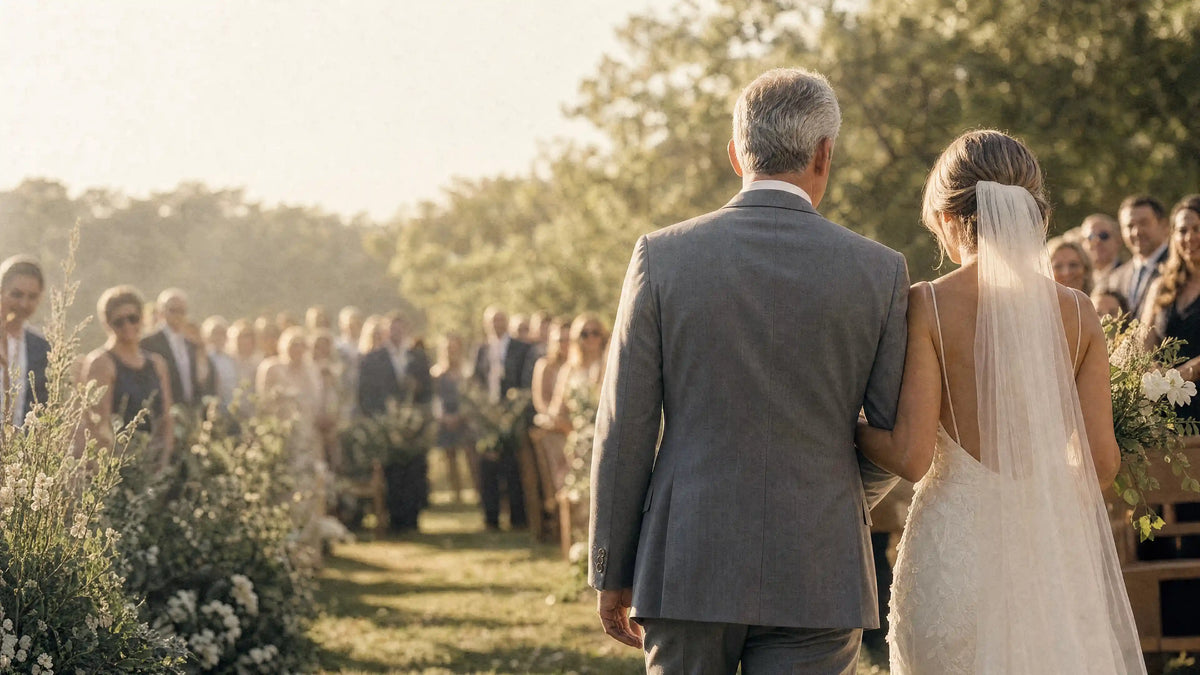
You will wear this suit on the most photographed day of your life, standing still, being looked at, for hours. Every flaw an everyday suit hides through movement is exposed when you're standing at an altar or behind a top table. A collar that gapes. A jacket that rides up when you raise your arm. Trousers that break in the wrong place. The camera finds all of it.
A suit cut to your body doesn't do those things. The collar stays on your neck when you move. The shoulder follows your shoulder. You stop thinking about the suit, which is the entire point you should be present at your own wedding, not managing your clothing.
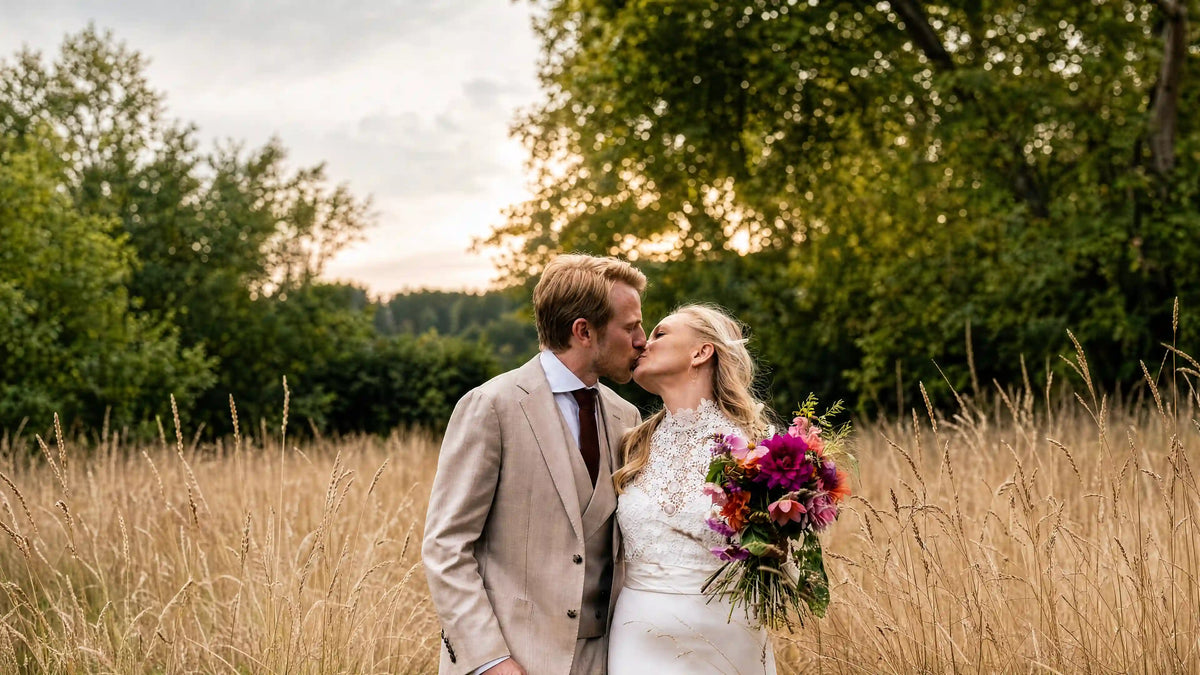
There's a second reason. A wedding suit made properly isn't single-use. Choose the cloth and the cut with some judgement and you have a suit you'll wear to every significant occasion for the next decade. I'll come back to that, because it changes how you should brief the commission.
Start 6 to 9 months out — here's the real timeline
The single most common mistake is leaving it late. Not because I can't work quickly, but because rushing removes the part that makes bespoke worth it: the fittings.
Here is how the timeline actually runs.
6 to 9 months before: First consultation. We talk through the wedding — venue, season, time of day, what your partner is wearing, what the wedding party is in. We look at cloth. I take your measurements and photograph your posture. This is also where I tell you honestly whether what you have in mind will work.
4 to 5 months before: First fitting, usually on a basted suit — the suit assembled in temporary stitching so I can take it apart and recut. This is where the real shaping happens. It will look unfinished. That's correct.
2 to 3 months before: Second fitting. The suit is now properly constructed. We're refining — sleeve length, trouser break, the seat, the collar. Small, exact adjustments.
3 to 4 weeks before: Final fitting and collection. The suit is finished, pressed, and yours. The buffer matters: if anything needs a final touch, there's time, and there's room for the small weight changes that happen in the run-up to a wedding.

If you come to me with eight weeks to go, I'll tell you straight whether I can do it properly. Sometimes the honest answer is that you'd be better served by made-to-measure done well than bespoke done in a hurry. I'd rather lose the commission than put my name on rushed work.
Choosing cloth: what actually matters for a wedding
Cloth is where grooms either overthink or underthink. Let me give you the framework I use.
Season and venue first. A July wedding in a marquee and a December wedding in a sandstone church need different cloth weights. Heavy cloth in summer is a mistake you'll feel by the speeches. Lightweight cloth in a cold church photographs thin. I match the weight to the day, then we talk colour and pattern.
Then the mills. I work with Holland & Sherry and Scabal for British and worsted cloths, Loro Piana and Piacenza for the softer Italian end, and Vitale Barberis Canonico for cloth that earns its keep across a range of weights. For most Northern weddings I steer grooms toward British milled wool it holds a press, it photographs with depth, and it lasts. A midnight blue or a deep charcoal in a good British cloth will serve you at the wedding and at every black-tie event after it.
Then the detail you can't see again until the photos. Lining, button choice, and the buttonholes. My buttonholes are hand-worked silk cut and stitched by hand, not punched by machine. On a lapel buttonhole, on a working cuff, it's one of the few signals other men who know clothing will read instantly. It is also, frankly, a detail you'll appreciate every time you do up your cuff for the next ten years.
The instinct on a wedding suit is to reach for something dramatic a bold check, a strong colour, a heavy texture. I usually pull grooms back from the edge of that. Not because drama is wrong, but because you're choosing for two audiences: the man on the day, and the man looking at the photographs in fifteen years. The second man rarely thanks the first for the novelty cloth.
What it costs, and what you're paying for
I'll be direct about money because evasiveness here is a tactic and I don't use it.
A bespoke commission with me starts from £2,500, priced on the cloth and on the hours of hand-work the construction takes. A wedding suit in a good British cloth, fully canvassed, hand-cut, with hand-worked buttonholes, sits at that entry point and climbs with the cloth you choose — well above made-to-measure and far above the high street. That's not a markup for the occasion. It's the cost of a pattern drafted for one body, cloth cut by hand, and three or four fittings of a cutter's time.
What you're buying breaks down like this. The cloth itself. The pattern, drafted and kept. The construction — the floating canvas, the hand-padding, the hand-finished details. And the fittings, which is the labour that turns a well-made suit into one that's actually yours.
Here's the part most guides skip. Divide the cost by the number of times you'll wear it. At £2,500, a suit you wear once is expensive at any price. A midnight blue suit you wear to the wedding, then to every formal occasion for a decade, costs you very little per wearing and looks better each year as the canvas settles to your chest. Commission it with the second life in mind and the maths changes completely.
How I work: privately, and on your time
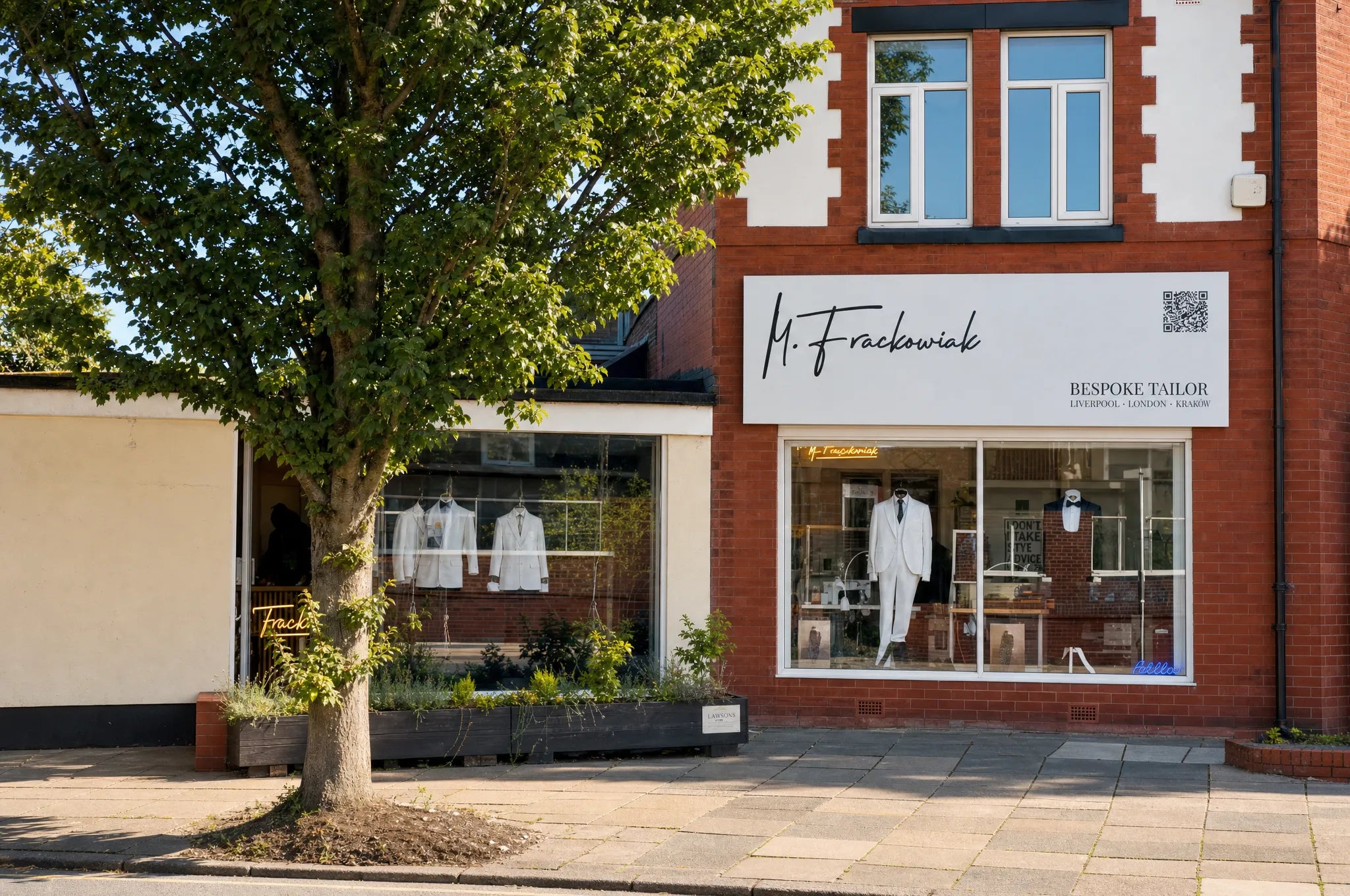
I don't have a shop floor. I never have. Every consultation happens at my studio at the Royal Albert Dock in Liverpool, or at your home or office if that's easier — which for a lot of the directors, partners and founders I work with, it is.
This isn't a luxury affectation. It's practical. Fitting a suit properly takes focus and time, and neither happens well with a sales floor's foot traffic and pressure. When you sit down with me, the hour is yours. We're not working around other customers. You're not being moved along.
It also means I see how you actually live and move. A man who's on his feet presenting all day needs a different jacket from a man who sits across a boardroom table. A groom needs a suit he can raise a glass and pull his new spouse onto a dance floor in without thinking about it. I can only build that if I understand the life the suit is going into.
For grooms outside Liverpool across the North West, or men who'd consider Savile Row but won't give a day to travelling to London for each fitting this is the point. You get cutting and construction held to the standard I learned working alongside Savile Row cutters, without the journey. The work travels to you.
What to do before you contact any tailor
So you can brief the commission properly with me or anyone — sort these four things first.
Know your date and your venue. Season, time of day, indoor or outdoor: these decide cloth before anything else.
Know roughly what your partner and the wedding party are wearing. The suit has to sit inside the day's whole picture, not fight it.
Think honestly about the suit's second life. If you want one suit that does the wedding and then years of formal events, say so at the first meeting. It changes the cloth and the cut.
And start early. Six to nine months gives us room to do it without compromise. That's the whole difference between a suit that's nearly right and one you forget you're wearing because it fits like it grew there.
When you're ready, that's the conversation I have every week. You can find my work on Instagram at @michael_frackowiak or reach me through michaelfrackowiak.com. Bring the date and the venue. We'll start from there.