The honest answer on hiring vs buying a wedding suit
I'm a bespoke tailor. You'd expect me to tell you never to hire a wedding suit.
I won't.
There are men I've sent toward hire because it was the right answer for their wedding, their budget, and their timeline. There are men who've come to me after hiring once and never wanting to do it again. Both of those are useful stories, and the honest version of this comparison contains both.
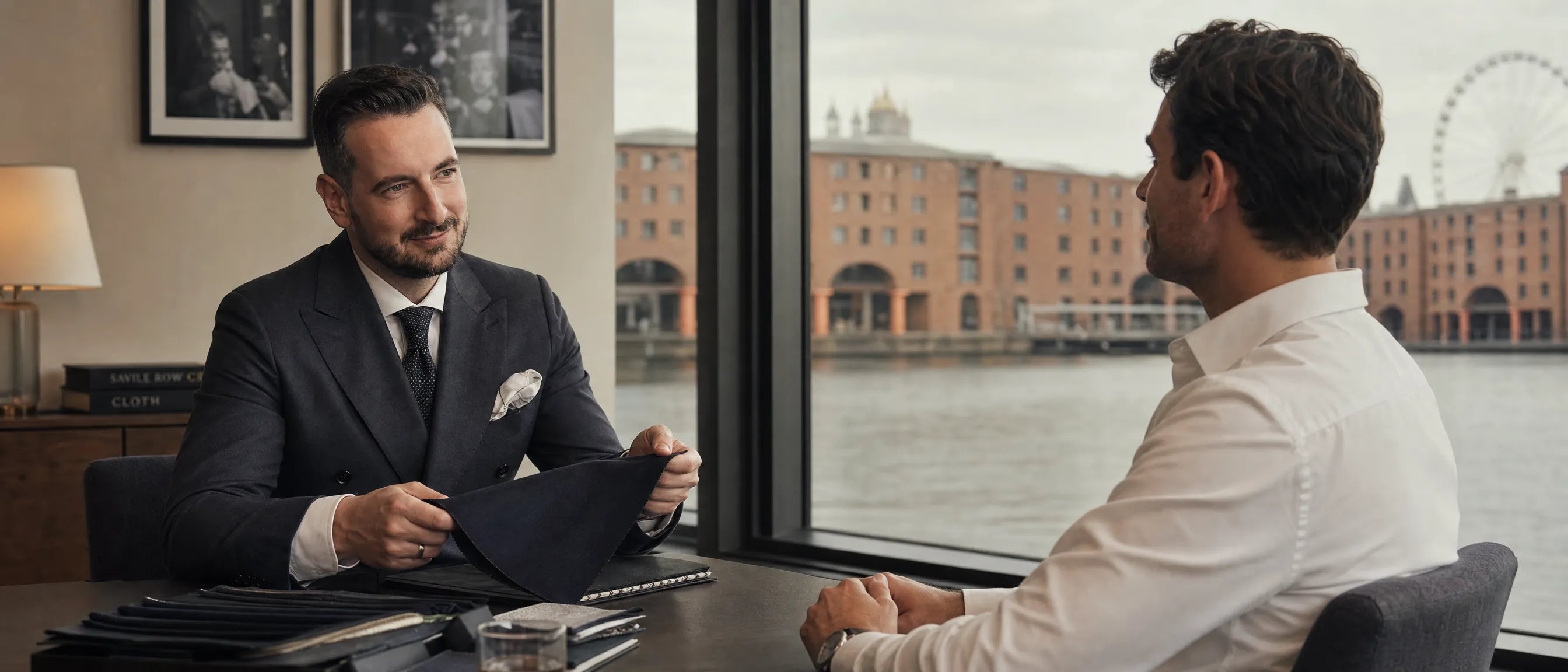
What follows is the conversation I have with grooms who come to my Royal Albert Dock studio still weighing the question. By the end you'll know which side of the line you sit on, and why.
The three things you're actually choosing between
Most grooms in Liverpool think they're choosing between two options: hire or buy. The real landscape has three.
Hire. You pay between £40 and £160 for the day. The suit goes back. It was worn last weekend by another groom of roughly your size, and it'll be worn next weekend by the next.
Off-the-peg or made-to-measure. You buy a suit. Off-the-peg is a stock size with alterations. Made-to-measure adjusts an existing block pattern to your measurements. Prices range from around £200 at the high street to £1,500 at the better end. You own the suit.
Bespoke. A new pattern is cut from paper for your body. The jacket is built around a hand-padded floating canvas. The buttonholes are worked in silk by hand. You own the suit, and you own the pattern that made it. From £1,700 upward depending on cloth.
These are not three points on the same spectrum. They are three different products that happen to share a shape. Treating them as the same thing is where most of the regret in wedding-suit buying comes from.
What I look at when a groom asks me which to choose
After twelve years cutting suits in Liverpool, I've narrowed the decision to four questions. They're the ones I'd ask you over coffee before saying anything about my own work.
1. How many weddings are you in this year, and the next?
If you're the groom once and a guest twice, the maths shifts. A man wearing a suit four times across two summers gets different value from owning than from hiring. A man with one wedding and no foreseeable formal events afterward has a genuine case for hire. I've told grooms exactly this and watched them leave the studio relieved.
2. What do you want the photographs to do for the next forty years?
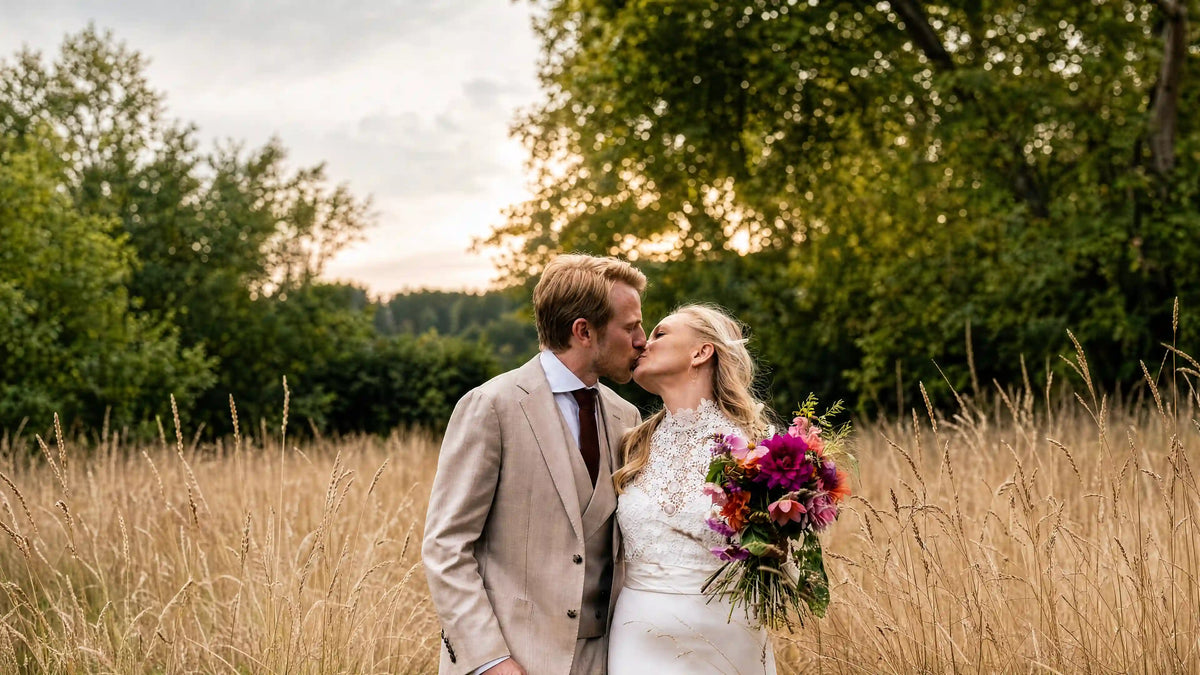
Wedding photographs hang on walls. They get pulled out at anniversaries. Your children will see them. The suit in those photographs either reads as yours or as something you put on for a day. That difference is visible in the picture even if you can't name what you're seeing — the shoulder sits forward, the collar gaps, the trousers break wrong at the shoe. A hired suit can look fine in person and wrong in a photograph, and the photograph is the thing that lasts.
3. What's your build?
If you're close to a standard block — average shoulder width, no significant asymmetry, proportional torso to leg — hire and off-the-peg can serve you reasonably. If you're not — broader across the chest, longer in the back, one shoulder higher than the other, a build that's been working against every suit you've ever worn — no amount of alteration on a stock garment will fix it. Bespoke is the only category that starts from your body rather than from someone else's pattern.
4. What does the suit do after the wedding?
This is the question grooms answer most carelessly. "I'll wear it again." Sometimes that's true. More often the suit sits in a wardrobe because the cut was wedding-specific and doesn't translate to the office. A bespoke suit can be commissioned in cloth that works for the wedding and for the next decade of professional life. That changes the cost-per-wear calculation more than most men realise.
The bespoke standard, briefly
So you can compare cleanly, here's what's in a suit I cut. Not as a sales pitch — as a reference point against which to measure anything else you're shown.
A pattern drafted by hand from twenty-eight measurements taken for you, kept on file at my studio. A floating canvas chest of horsehair and wool, hand-padded into the jacket front, which shapes itself to your chest over the first year of wear rather than bubbling after a summer of dry cleaning. Cloth from Holland & Sherry, Scabal, Loro Piana, Vitale Barberis Canonico, or Piacenza — the mill books sit on the table in front of you and you handle the cloth before you commit. Buttonholes cut and stitched in silk by hand, around forty minutes each. Three fittings minimum across ten to fourteen weeks. A baste fit held together in white thread, a forward fit closer to finished, a final fit before pressing.
That's the construction. Take any one element out and you have a different product wearing the same word.
For the Liverpool groom: the honest case for each route
Hire makes sense when: the wedding is in under three months, the budget is firmly under £400, the build is close to standard, and there's no realistic future use for the suit. A hired suit that fits acceptably and lets you stay present on the day is better than a bought suit that drained the budget and still doesn't sit right.
Made-to-measure makes sense when: you want to own the suit, the build is reasonable, the budget sits between £600 and £1,500, and the wedding is at least three months out. You'll get a better fit than hire, a suit that's yours, and a garment that can carry on into professional life if the cloth is chosen for it.
Bespoke makes sense when: you're six months or more out from the wedding, the budget allows it, the photographs matter at the level I described above, your build doesn't conform to a standard pattern, or you've reached a point in life where the suit is also the start of a wardrobe rather than a one-day purchase. Most of the grooms I dress at the Royal Albert Dock studio fall into the last category. They're a Managing Partner, a Director, a Founder marking a moment. The wedding suit is the first of three or four I'll make for them across the next decade.
If you're not in one of those situations, I'll say so. I've sent men toward hire from a first consultation. The point of the conversation is to find the right answer, not to sell mine.
For the professional: the same question with different stakes
Most of the Liverpool professionals who come to me first met me through a wedding commission. The pattern I cut for the wedding sits in my archive. Two years later they come back for a working wardrobe, and we start from a pattern that already knows their body.
That's the part of the calculation grooms underestimate. A bespoke wedding suit is not only the wedding suit. It's the foundation pattern for every suit that follows. A Director in Liverpool city centre or a Founder operating between the North West and KAFD doesn't pay the full cost of bespoke twice. The second commission and every one after sits on work I've already done.
A hired suit ends when the day ends. A bespoke suit becomes the start of a relationship between a man and the clothes he works in.
The objection I hear most
"Surely £1,700 is hard to justify against £150 for a hired suit."
On the face of it, yes. £1,700 is more than £150. The arithmetic on a single day is not in my favour.
The arithmetic across a decade is different. A bespoke suit, looked after, wears for fifteen to twenty years. The cost-per-wear on a wedding suit that goes on to serve as a working suit for ten years drops to something between £8 and £15 per wearing. The same suit hired for one day costs £150 per wearing, with the additional cost that you don't own it and can never wear it again.
That is not an argument that bespoke is right for everyone. It's an argument that the single-day comparison is the wrong frame. The honest question is not "what does this cost on the day" but "what does this cost across the life of the garment."
For a groom whose suit will be worn once and never again, hire wins. For a groom whose suit will carry into professional life, the maths inverts.
A checklist before you commit to anything
Use these questions on any tailor, hire shop, or made-to-measure service you're considering.
Will my suit be built from a new pattern cut from scratch, an adjusted block pattern, or a stock size? The honest answer to this changes the category of what you're buying.
Is the canvas in the jacket chest floating and hand-padded, or fused to the cloth with adhesive? Fused fails. Floating canvas lasts.
Can I see and handle the cloth before I commit, and can the mill be named? If the bunches are unbranded and the mill can't be cited, ask why.
How many fittings are included, and across what timeline? Bespoke needs three fittings across ten to fourteen weeks. Anything compressed below that is a different product.
Where do fittings take place, and who conducts them? The man cutting the pattern should be the man fitting the suit.
If I'm hiring, when was this suit last cleaned, and how many men have worn it this season? A reasonable hire shop answers without flinching.
What happens if the fit isn't right at the final fitting? The answer should arrive without defensiveness.
A vague answer on any of these is the answer.
FAQ
How much does a wedding suit cost in Liverpool?
The honest range is £40 to £160 for hire, £200 to £600 off-the-peg, £600 to £1,500 made-to-measure, and £1,700 upward for bespoke. Each is a different product, not a different price point of the same thing.
How long before the wedding should I start?
For hire, four to six weeks works. For made-to-measure, three months minimum. For bespoke, six months is comfortable; nine to twelve is better. If you're inside three months and set on bespoke, call me and I'll tell you honestly what's achievable.
Is bespoke worth it if I'll only wear the suit once?
Probably not. If the suit genuinely sits in a wardrobe after the wedding, the cost-per-wear doesn't justify itself. Bespoke makes sense when the suit becomes the start of a wardrobe, not the end of a day.
What's the difference between bespoke and made-to-measure for a wedding suit?
Bespoke begins with a new pattern drafted from your measurements. Made-to-measure begins with an existing block pattern adjusted to fit. Both can produce a wearable suit. Only one is built from a pattern that did not exist before you commissioned it, and only one stays in the archive for future work.
Can I get a bespoke suit if my build is unusual?
Yes. This is where bespoke earns itself. Significant asymmetry, broader shoulders, a longer or shorter torso, a high hip — a standard block will never resolve these. A pattern cut from your measurements will. The men with the most to gain from bespoke are often the ones who've been told their whole lives they're hard to fit.
Do I have to come to the studio?
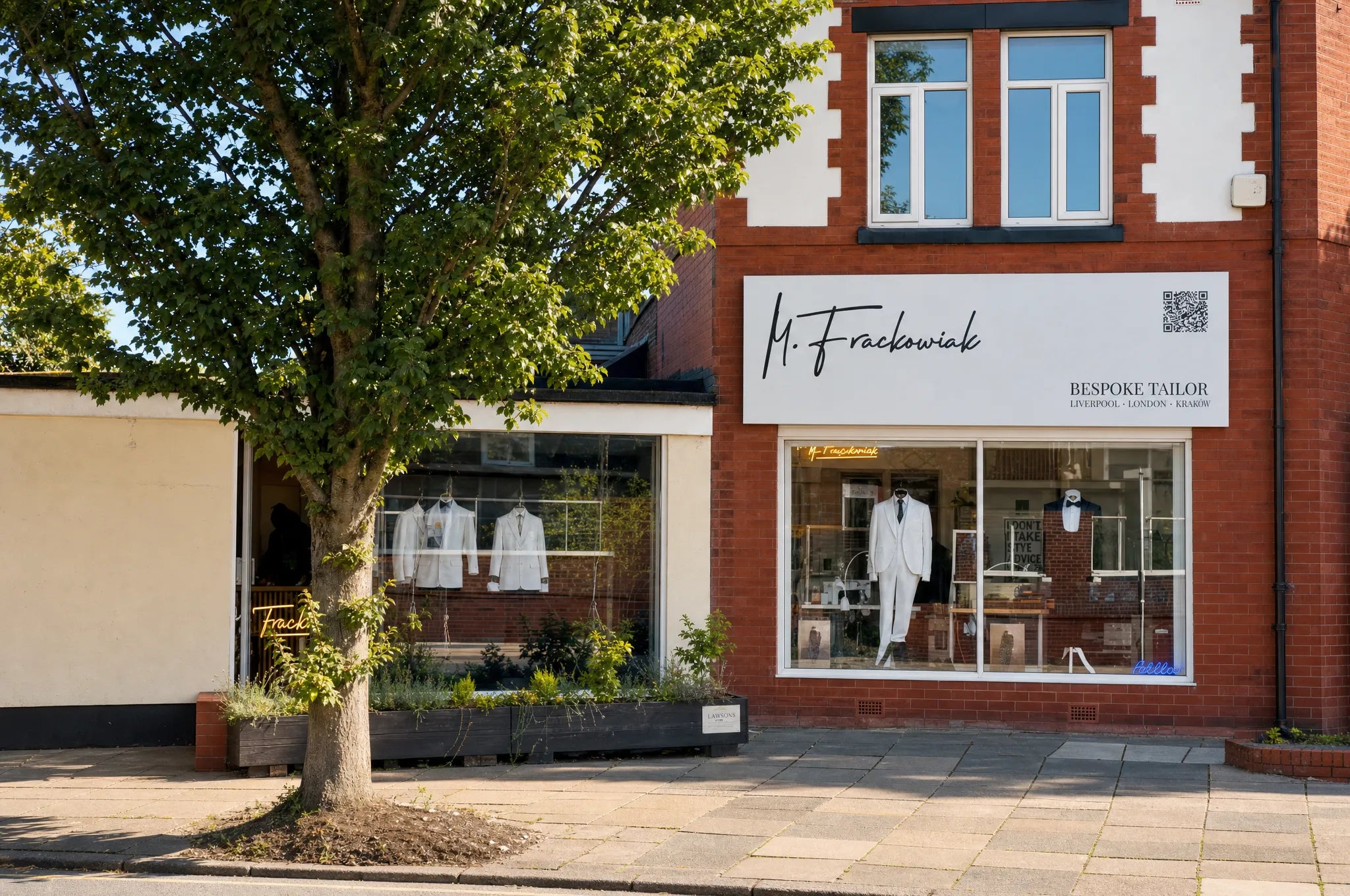
No. I see clients at my Royal Albert Dock studio, at their office in Liverpool city centre, at home anywhere across Merseyside or the North West, or at a hotel suite if that suits the diary. For clients operating between Liverpool and the Gulf, I also work from a studio in Wadi Qortuba, Riyadh, with regular travel between the two.
What cloth do you recommend for a wedding suit?
It depends on the season, the venue, and what the suit needs to do afterward. A 280–320g British milled wool from Holland & Sherry or Vitale Barberis Canonico carries from wedding day into professional use across most of the year. For a summer wedding or a Gulf-based ceremony, lighter Italian cloth from Loro Piana or Piacenza handles the heat without losing structure. We choose it together with the mill books on the table.
Will the suit fit me in ten years if my body changes?
Within reason, yes. Bespoke jackets are cut with internal seam allowances that allow a competent tailor to let out the waist, the seat, and the chest within useful margins. The pattern on file gets refined rather than re-drafted. This is part of what you're paying for.
Do you make wedding suits for groomsmen as well as the groom?
I do, when the groom wants the wedding party in coordinated bespoke or made-to-measure. Most often the groom commissions bespoke for himself and we work out a coordinated approach for the party in a category that fits their budget and timeline. There's no pressure for the wedding party to match the groom's commission.
Closing
If you've read this far, you already know more about the decision than most men do when they walk into their first appointment. That's the point.
The next step isn't a booking. It's a conversation. Coffee at my Royal Albert Dock studio, your office in Liverpool city centre, or your home in the North West. Forty-five minutes. No tape measure unless you ask for one. I'll tell you honestly which of the three routes is right for you, and if it isn't mine, I'll say so.
You can find me on Instagram at @michael_frackowiak or at michaelfrackowiak.com. The studios are at the Royal Albert Dock in Liverpool and Wadi Qortuba in Riyadh.
For men whose presence carries consequence.
Michael