
Article: A Brief History of the Tuxedo: Origins, Name & Style
A Brief History of the Tuxedo: Origins, Name & Style
The history of the tuxedo begins in Victorian England in the 1860s, when the Prince of Wales wanted a shorter, more comfortable alternative to the formal evening tailcoat for private dinners. The style crossed the Atlantic in 1886, reached the Tuxedo Club in Tuxedo Park, New York, and took the name of the place where Americans first saw it. In Britain it is still called the dinner jacket.
I am Michael Frackowiak, a bespoke tailor working from private studios in Liverpool and Riyadh. I make dinner suits for weddings, galas and black tie dinners, and nearly every client asks me the same question at the first fitting: why does it look the way it does? This guide is my answer. It covers where the tuxedo came from, why it carries that name, how it changed over 160 years, and what that history means for a man buying one today.
In short, a tuxedo is a formal evening suit worn for black tie, set apart by silk on the lapels, the buttons and the trouser stripe. I have covered what a tuxedo is and how it differs from a suit in my guide to the tuxedo and the suit, so here I will focus on how the tuxedo came to exist and why it looks the way it does.

Where did the tuxedo originate?
Before the tuxedo, a gentleman wore white tie in the evening: a black tailcoat cut away at the front, a white waistcoat, a stiff winged collar and a white bow tie. It was the only correct evening dress, and it was rigid and formal. People sometimes ask what a tuxedo with tails is called. The answer is a tailcoat, or evening tails, and it belongs to white tie rather than to the tuxedo family.
In the mid-1800s, wealthy men also owned a smoking jacket. This was a short, soft jacket, often in velvet with a shawl collar and quilted silk trim. After dinner, men left the ladies and moved to a smoking room, and they put on this jacket so the smell of cigar smoke stayed off their tailcoats. The shawl collar you see on many dinner jackets today comes directly from this garment.
The turning point came around 1865. The Prince of Wales, later King Edward VII, asked the London tailoring house Henry Poole & Co for a short evening jacket in dark cloth to wear at relaxed dinners at Sandringham, his country estate. It kept the dark colour and silk trim of evening wear but dropped the tails. That jacket is generally seen as the ancestor of the modern dinner jacket.
So the honest answer to "where was the tuxedo invented" is England, in the bespoke workrooms of London. The name came later and from somewhere else.
Why is it called a tuxedo?
The tuxedo is named after Tuxedo Park, a private community north of New York City, founded in 1886 by the tobacco heir Pierre Lorillard IV. Its social centre was the Tuxedo Club, home to some of the richest families in America.
There are two well-known origin stories, and both point back to the same autumn.
- The Potter story. In 1886 the New York socialite James Brown Potter and his wife Cora visited England and were invited to dine with the Prince of Wales. Potter asked what he should wear, and the Prince sent him to his own tailor for a short evening jacket. Potter brought it home, and fellow members of the Tuxedo Club copied it. The Tuxedo Club itself favours this version.
- The Lorillard story. At the club's first Autumn Ball in October 1886, Griswold Lorillard, son of the founder, and his friends arrived in tailless black jackets. Some guests were shocked, because a jacket without tails looked half-dressed to them. The look spread quickly anyway.
Both stories may hold some truth. Either way, New Yorkers began calling the jacket "the Tuxedo", after the place where it was worn, and the short form "tux" followed. As for what the word tuxedo means, it is usually traced to a Lenape (Native American) place name for the area, though historians disagree on its exact meaning. If you have ever wondered how to spell tuxedo, it keeps the spelling of the town: T-U-X-E-D-O, with "tuxedos" as the plural.
Tuxedo, dinner jacket or smoking: what the world calls it
If you ask what a tuxedo is called in England, the answer is a dinner jacket, or a dinner suit when you mean the jacket and trousers together.
| Country or region | Common name | Where the name comes from |
|---|---|---|
| United Kingdom | Dinner jacket or dinner suit | It was worn to dinner in place of the tailcoat |
| United States and Canada | Tuxedo or tux | Tuxedo Park, New York, 1886 |
| France, Italy, Germany and much of Europe | Smoking, or smoking suit | Its roots in the Victorian smoking jacket |
| Saudi Arabia and the Gulf | Tuxedo (in English-language settings) | American usage on invitations and at international events |
Whatever the name on the invitation, the dress code is the same: black tie.
How the tuxedo became black tie
For its first few decades the dinner jacket was informal evening wear. You wore it at home, at your club or at a small private dinner. For balls, the opera and formal dinners with ladies present, white tie and tails remained the rule.
That changed after the First World War. Society relaxed, dances became livelier, and younger men wanted something more comfortable than a starched tailcoat. Through the 1920s and 1930s the dinner jacket moved from the private dining room to restaurants, nightclubs and theatres. By the end of the Second World War it had largely replaced white tie as the standard evening dress for most men. White tie survives today mainly at state banquets, some balls and a small number of very traditional events.
This history explains why black tie today means a dinner suit and a black bow tie rather than a dark lounge suit, and why morning dress, with its morning coat, is a separate daytime code and not a tuxedo at all.

A timeline of the history of the tuxedo
| Period | What happened | Detail you still see today |
|---|---|---|
| 1850s to 1860s | Smoking jackets worn after dinner; white tie is standard evening dress | The shawl collar |
| Around 1865 | Henry Poole & Co makes a short evening jacket for the Prince of Wales | Dark cloth with silk facings |
| 1886 | The style reaches the Tuxedo Club in New York and gains its American name | The word "tuxedo" |
| 1900s to 1910s | Accepted for informal evenings, still below white tie | The single-breasted, one-button jacket |
| 1920s to 1930s | Becomes fashionable at restaurants, nightclubs and theatres; midnight blue, double-breasted and white dinner jackets appear | Midnight blue cloth, the cummerbund, the white jacket for warm climates |
| 1940s to 1950s | Replaces white tie for most occasions after the Second World War | Black tie as the default formal code |
| 1960s | Slim cuts; the dinner jacket becomes a film icon; Yves Saint Laurent launches Le Smoking for women in 1966 | Narrow lapels and a clean silhouette |
| 1970s | Coloured jackets, ruffled shirts, wide lapels and flared trousers | Mostly a lesson in what dates badly |
| 1980s to today | A return to classic black and midnight blue, with slimmer, more tailored fits | The modern dinner suit |
The parts of a tuxedo and why each one exists
Every detail on a proper dinner suit has a reason behind it. Once you know the history, the rules make sense and stop feeling arbitrary.
The jacket: lapels and silk facings
The facings on the lapels come from the smoking jacket, where silk trim added a touch of luxury to a garment worn in private. Today they are either satin, which is smooth and bright, or grosgrain, which has a fine ribbed texture and a quieter shine. I usually guide clients toward grosgrain, because it photographs well and looks expensive without being flashy.
Shawl collar, peak lapel or notch lapel
A shawl collar tuxedo has one smooth, rounded lapel line with no notch, taken straight from the smoking jacket. It is the oldest dinner jacket style. A peak lapel tuxedo borrows its lapel from the tailcoat, the most formal garment of all, and the points rise toward the shoulder. Both are correct. A notch lapel tuxedo, borrowed from everyday suits, appeared later and is the least traditional choice for black tie, which is why many tailors steer clients away from it.

Single-breasted or double-breasted, and how many buttons
The classic single-breasted dinner jacket has one button. That single button keeps the front clean and lets the lapels and shirt front do the work. A double-breasted tuxedo, popular since the 1930s, usually has four or six buttons with one or two that fasten. Do you button a tuxedo jacket? Yes, when you stand. Undo a single-breasted jacket when you sit, and keep a double-breasted one fastened.
The trousers: a single stripe and no belt
Dinner suit trousers (tuxedo pants in the US) carry one silk braid down the outside seam. It matches the lapel facings and hides the seam. White tie trousers traditionally carry two stripes, which is one small way to tell the two dress codes apart. Tuxedos do not have belts or belt loops. A belt buckle would break the clean line between jacket and trousers, so the trousers are held up by side adjusters or by braces.
The cummerbund and the waistcoat
The cummerbund comes from the kamarband, a waist sash British officers saw while serving in India in the 19th century. Officers adopted it as a cooler alternative to a waistcoat in hot weather. Its job is to cover the waistband, so the white shirt never shows between the jacket button and the trousers. A low-cut evening waistcoat (a vest in the US) does the same job and is the more traditional choice in cooler weather. Does a tuxedo need a vest? Not strictly. A waistcoat or cummerbund is the correct finish with a single-breasted jacket, but a double-breasted jacket covers the waist and needs neither.

The tuxedo shirt
A tuxedo shirt is a white evening shirt made to be worn with black tie. The traditional version has a stiff bib front in marcella (cotton piqué), while the softer and more common style has a pleated front. It closes with studs rather than ordinary buttons and has double cuffs (French cuffs) fastened with cufflinks. A turndown collar is the classic choice for black tie. The stiff wing collar belongs to white tie, though many men wear it with a dinner jacket today.
The bow tie
Black tie takes its name from the black silk bow tie, ideally one you tie yourself. Can you wear a regular tie with a tux? You can, and some modern weddings do, but a long necktie is no longer true black tie. If the invitation says black tie, wear a bow tie.
The cloth
What is a tuxedo made of? Traditionally a fine black or midnight blue wool, often a barathea or a smooth grain de poudre, sometimes blended with mohair for a subtle sheen and crease resistance. The best material for a tuxedo is the one that suits where you will wear it: a lighter wool or wool and mohair for warm rooms and hot climates, a heavier cloth for a British winter.
Midnight blue and other tuxedo colours
In the 1920s and 1930s, fashionable men noticed that under artificial light, a very dark navy cloth looked richer and blacker than black itself, which can take on a slightly green or grey cast. The Duke of Windsor is often credited with popularising midnight blue. I still recommend it to many clients today, especially for evening photography. Beyond black and midnight blue, the other traditional tuxedo colours are ivory for warm climates and deep velvet jackets in burgundy, bottle green or navy for less formal evenings.
The white dinner jacket
In the 1930s, men at resorts and in hot countries began wearing ivory or white dinner jackets with black trousers. It was a practical answer to warm evenings, and it is often called a summer tuxedo. This history is very relevant to my clients in Riyadh, and I cover cloth and construction for heat in my guide on how a suit survives a Riyadh summer.

The tuxedo on screen and the women who wore it
Film did more than anything else to make the tuxedo glamorous in the 20th century. Fred Astaire danced in evening dress through the 1930s, and Sean Connery's midnight blue shawl collar dinner jacket in Dr. No (1962) set the template for James Bond. If you enjoy that side of tailoring, I have written about the most iconic suit looks in film and what each one teaches.
The tuxedo also became a symbol of confidence for women. Marlene Dietrich wore one on screen in Morocco in 1930, which was considered daring at the time. In 1966 Yves Saint Laurent introduced Le Smoking, a tuxedo cut for women, and that name is still the best answer to what a female tuxedo is called.
How "tuxedo" became a word for black and white
The tuxedo became so familiar that its name spread to anything black with a white front. A tuxedo cat is not a breed; the name simply describes a black and white coat that looks like evening dress. The penguin is the animal most often described as always wearing a tuxedo. And the "Canadian tuxedo", a denim jacket worn with jeans, is a joking nod to the real thing. Men have also called the tuxedo a "monkey suit" for decades, usually when they did not want to wear one.
What the history of the tuxedo teaches us about buying one today
Here is the practical lesson from 160 years of history. The dinner suits that look best decades later are the ones that stayed close to the original idea: dark cloth, clean lines, silk facings, nothing added for fashion's sake. The 1970s ruffles look dated. A well-cut midnight blue shawl collar jacket from the 1930s still looks right today.
The tuxedo was also born as a bespoke garment. The first one was cut by hand for one man, and fit was the whole point. That is still true. A dinner jacket shows everything: the shoulder line, the way the lapel rolls, how cleanly the jacket closes over a single button. Poor construction has nowhere to hide.
What is a bespoke tuxedo?
A dinner jacket should fit more closely than a day suit, long enough to cover your seat and closing cleanly over one button.
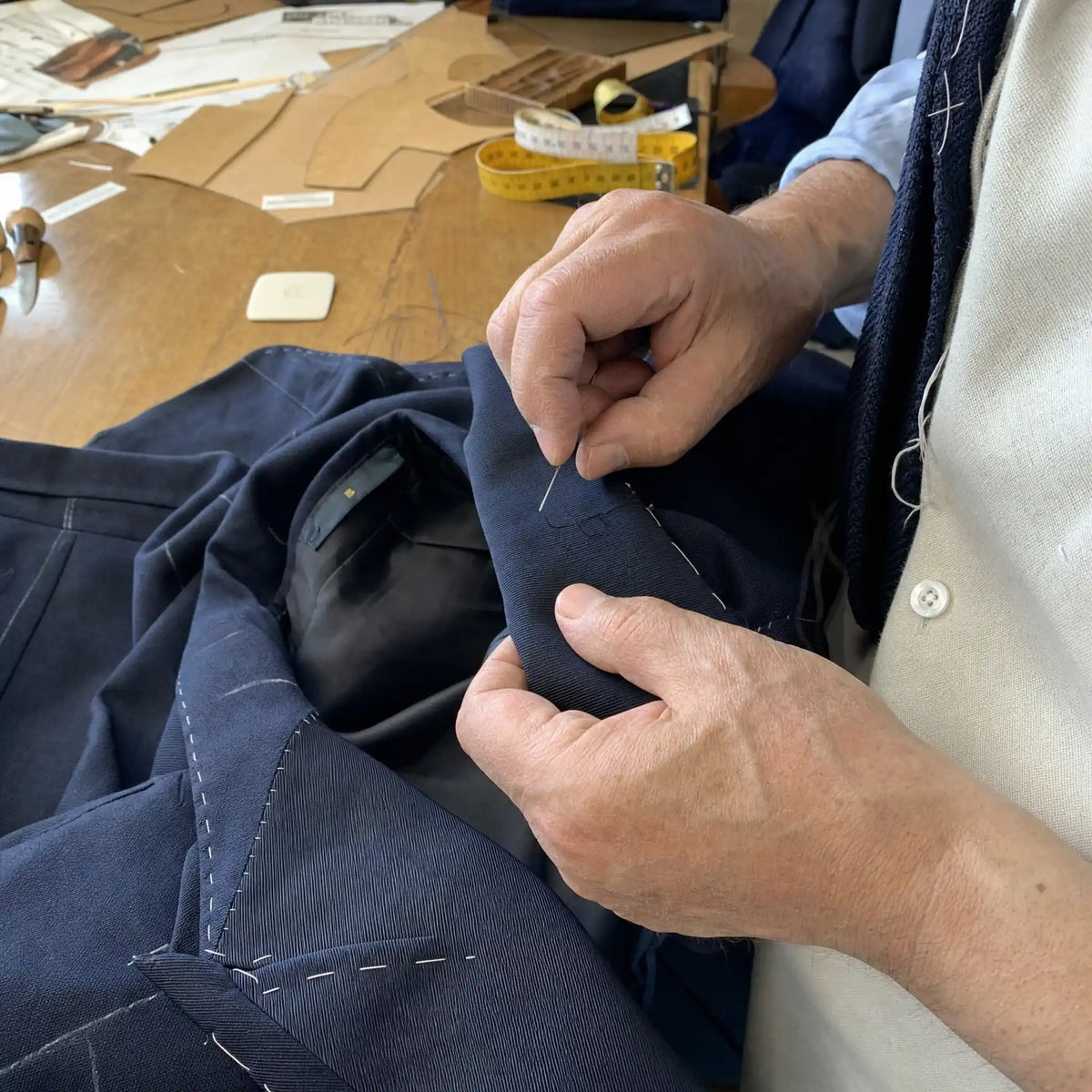
A bespoke tuxedo is cut from a pattern drafted for your body alone and built by hand over several fittings. When I make a dinner suit, I follow the same construction standard I learned training alongside Savile Row cutters. Each client gets a hand-drafted paper pattern kept on file, a floating horsehair and wool canvas, hand-shaped lapels and hand-worked silk buttonholes. I cut from cloths by British and Italian mills including Holland & Sherry, Scabal, Loro Piana, Vitale Barberis Canonico and Piacenza. Made and cared for properly, a dinner suit like this can last fifteen to twenty years, which suits a garment you might wear only a few times a year. I go into the wider case in why bespoke clothing is worth it.

When bespoke is not the right answer
I will be honest. If you need black tie once, for one event, and do not expect to wear it again, hiring is a sensible choice. The average cost of renting a tuxedo in the UK is roughly £40 to £160, and a rental usually includes the jacket, trousers and often the shirt and bow tie. Bespoke also takes time, six to eight weeks from consultation to final fitting, so it does not suit a last-minute invitation. For a wedding, I suggest starting six to nine months before the date so the fittings can be spread out comfortably.
When to wear a tuxedo in Liverpool and Riyadh today
You wear a tuxedo when the invitation says black tie, and traditionally only after six in the evening. That covers black tie weddings, galas, charity balls, award dinners and some professional and regimental dinners. Wearing a tuxedo professionally is rare outside those events, but for men who attend several each year, owning one quickly makes sense.
In the UK, most of the dinner suits I make in Liverpool are for weddings, charity balls and professional dinners across the North West. You can read more about my work as a bespoke tailor in Liverpool, with consultations at Royal Albert Dock or at your home or office.
In Riyadh, black tie appears at galas, embassy receptions and award evenings, often alongside international conferences. Knowing the dress code for each event matters, and I have covered that in what men should wear to Riyadh business events. My clients in Riyadh meet me privately at my Wadi Qortuba studio or at their office in KAFD or Al Olaya. More detail is on my page for bespoke tailoring in Riyadh.
History of the tuxedo: frequently asked questions
What is the history of the tuxedo?
The tuxedo began in England around 1865 as a short evening jacket made for the Prince of Wales as a relaxed alternative to the tailcoat. It reached New York in 1886, where members of the Tuxedo Club in Tuxedo Park adopted it and gave it the American name. After the First and Second World Wars it gradually replaced white tie as standard formal evening wear.
Who invented the tuxedo?
No single person invented it. The Prince of Wales and his tailors at Henry Poole & Co are usually credited with the first short evening jacket. In America, James Brown Potter and Griswold Lorillard are both linked to its arrival at the Tuxedo Club in 1886.
What is a tuxedo named after?
It is named after Tuxedo Park in New York, where the style first became popular in America in 1886. The place name is generally traced to a Lenape word for the area.
Is a tuxedo British or American?
The garment is British and the name is American. In Britain it is still called a dinner jacket or dinner suit, while Americans call it a tuxedo.
What is the difference between a tuxedo and a dinner jacket?
There is no difference. They are two names for the same garment. "Dinner jacket" is the British term and "tuxedo" is the American one.
Why are tuxedos black?
They inherited their dark colour from Victorian evening dress, which was black. Midnight blue became an accepted alternative in the 1920s and 1930s because it looks deeper and richer under artificial light.
When did the tuxedo replace white tie?
The shift happened gradually between the 1920s and the late 1940s. After the Second World War, black tie became the standard for most formal evenings, and white tie was kept for the most formal occasions.
Why does a tuxedo have satin lapels?
The silk facings come from the Victorian smoking jacket, which used silk trim as a mark of luxury. Today they are made in satin or grosgrain silk and match the stripe on the trousers.
Should I wear a tux or a suit to prom?
Either is acceptable at most school proms unless the invitation says black tie. A tuxedo feels more special for the occasion, while a well-fitted dark suit is easier to wear again. Hiring a tuxedo is usually the sensible choice for a growing teenager.
How much does a bespoke tuxedo cost?
My bespoke work starts from £1,700 in the UK and SAR 8,500 in Riyadh. The final price depends on cloth and details such as facings and a matching waistcoat.
Commission a dinner suit with history in every stitch
The tuxedo started life as one man's request for a better-fitting evening jacket, cut by hand. That is still the best way to have one made. If you have a wedding, gala or black tie dinner ahead, I would be glad to talk through cloth, lapel style and timing with you.
Book a private consultation in Liverpool or Riyadh. You can also see recent dinner suits on Instagram.
For men whose presence carries consequence.

